Find the point where food disappears
Before choosing a container, record what went uneaten during an ordinary week. Separate preparation scraps from food that could have become another meal. A forgotten portion of rice, a soft cucumber and an unopened multipack have different causes. Better lids will not fix buying more than your household can use. A visible shelf might solve a problem that a storage set would only make more expensive.
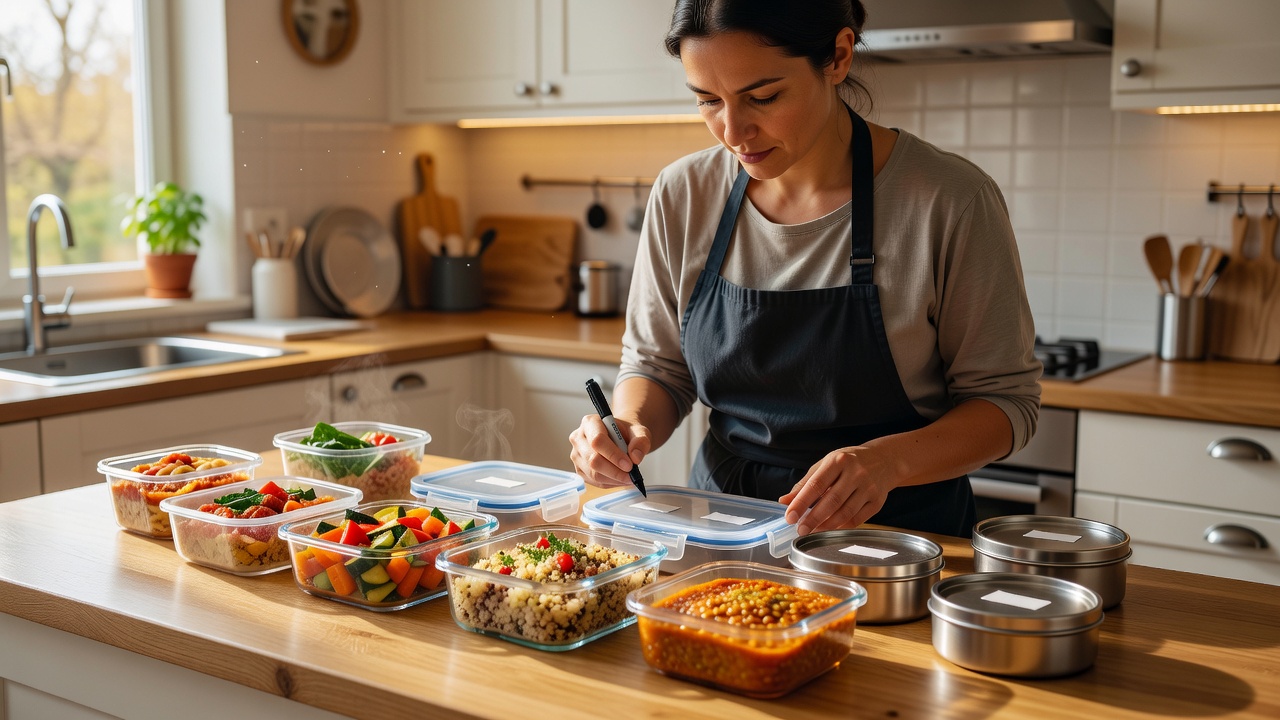
Give ready-to-eat leftovers an obvious place, away from raw food that could contaminate them. Put a simple date and contents label on anything that will become hard to recognize. Check this space before planning dinner or shopping. The routine matters more than the label style: masking tape or a washable marker may be enough if appropriate for the container.
Keep sound storage in service
Take stock of your existing containers and match each one with its lid. Check manufacturer instructions for food contact, freezer use, reheating and dishwasher cleaning. Do not assume a takeaway tub is designed for repeated heating. Retire containers that are cracked, badly distorted or otherwise no longer suitable for their intended use. A missing seal may be replaceable; a damaged food-contact surface may not be.
Glass can make leftovers easy to see, but it is heavy and can break. Some types tolerate heating and freezing; others do not. Avoid sudden temperature changes and follow the maker’s instructions. Lightweight plastic may be more practical for someone who cannot lift a heavy dish. Stainless steel is durable for many cold-storage tasks, but ordinary metal containers do not belong in a microwave. No material wins every household situation.
Match capacity to a real meal
Large containers can conceal small portions and encourage repeated handling. A few appropriately sized containers are often more useful than a large matching set. Think about a lunch serving, a family portion of soup and the space available on a freezer shelf. For liquids that will freeze, use a freezer-suitable container and leave the headspace its instructions require.
Keep an inventory of frozen portions where you will see it. Use the oldest suitable food first and cross it off when it leaves the freezer. Freezing does not make previously unsafe food safe, and it does not erase handling mistakes. Plan safe thawing ahead of time rather than leaving perishable food on the counter to catch up with dinner.
Let safety set the boundaries
The United States Department of Agriculture advises refrigerating perishable food within two hours, or within one hour when the temperature is above 90°F / 32°C. Its guidance is to keep a refrigerator at 40°F / 4°C or below. Divide large amounts of cooked food into shallow containers for prompt chilling; do not leave a large pot out until it reaches room temperature. Different foods and local guidance may require additional precautions.
USDA guidance commonly gives refrigerated leftovers a three-to-four-day window, but this is not a universal rule for every food or circumstance. Consult the FoodSafety.gov storage charts and relevant product instructions. The US Food and Drug Administration offers additional safe-handling guidance. Smell and appearance cannot reliably detect harmful bacteria. Never taste questionable food to decide whether it is safe.
Store produce with a purpose
Start with the produce that repeatedly spoils. Keep moisture-sensitive leaves from sitting in excess water and follow guidance for the particular fruit or vegetable. Do not automatically wash everything before storage: some foods keep better when washed just before use. Clean hands, utensils and surfaces remain important. A cloth used around food needs its own washing and drying routine, rather than permanent residence in the vegetable drawer.
WRAP’s Love Food Hate Waste guidance can help with practical storage and portion planning. Its ideas are most useful when adapted to your household rather than treated as a shopping list. If you regularly discard half a large pack, a smaller pack may prevent more waste even when its packaging-to-food ratio looks less attractive. The relevant outcome is food eaten, not the tidiness of a photograph.
Review the result, not the collection
After two weeks, look for fewer forgotten portions and fewer duplicate purchases. Note whether washing seals, finding lids or lifting containers has become a barrier. Change one part of the system before adding more equipment. A useful purchase should solve a demonstrated gap, have straightforward care instructions and ideally offer replacement lids or seals. Keep the containers that work; let the routine earn any expansion.